Shine Energy Systems Geothermal Blog

This is the Shine Energy Systems Inc. blog for all things geothermal, geoexchange, or groundsource - depending on what you want to call it.

Shine Energy Systems Geothermal Blog header image 1

In the Thick of It

July 24th, 2008 · No Comments

We have not blogged in quite some time as we are in the midst of a busy installation period.  Here are just a few photos of the sites showing how different the installation process can be for each site.

For Site 1: This is a photo showing the trenching layout designed to maintain the trees existing on site.

imgp0772-small.JPG

Site 1 had some sandy water, so we’re running it through the filter on our purge cart prior to pressurizing the system for leak testing.

Filtering

Site 2 is a textbook case for geothermal installation: plenty of space, not a rock to be found, and easy digging.

imgp0802-small.JPG

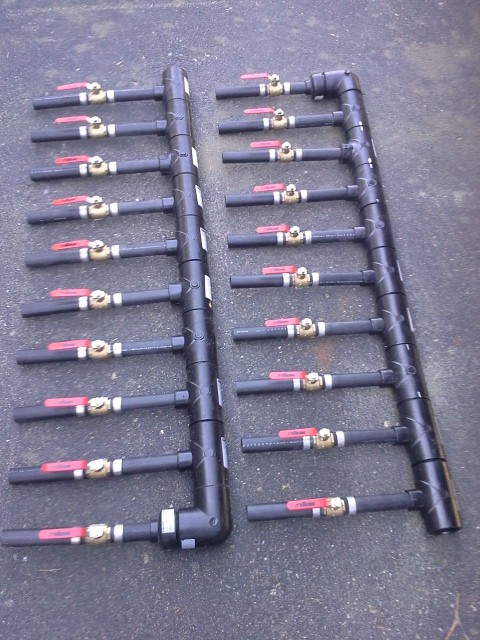
Site 2 showing the header lines running through the footing to the future location of the mechanical room.  Note there are 4 pipes as there are two units (radiant and forced air).

imgp0805-small.JPG

Site 3 is different in that we went for a pit installation to best fit the property constraints.

Pit Design

Site 3 showing off the perfect pressure test score.

The perfect pressure test.

→ No CommentsTags: news · geothermal

Top Ten Things to do with your $100

June 4th, 2008 · No Comments

British Columbia’s new carbon tax comes in effect on July 1st.

As part of the new tax plan, carbon-based fuels — including gasoline, diesel, natural gas, propane, coal and home heating fuel — will be taxed at $10 per tonne of greenhouse gases generated, starting July 1, 2008.

That will translate into a new 2.4 cents per litre tax on gasoline at the pump and 2.8 cents per litre for home heating fuel.

The carbon tax rate will rise by $5 a year for the next four years, until it hits $30 per tonne of greenhouse gas generated in 2012, said Taylor.


CBC, February 20, 2008

The provincial government will be offering a $100 Climate Action Dividend. The first (of hopefully many) rebates should be arriving in every persons mailbox in the weeks leading up to July 1st. So I’ve come up with the ‘Top Ten Things to do with your Rebate’.

10. Buy yourself a tank of gas or diesel. You’re being taxed on it, so the extra 2.4 cents/litre (for now) might just find its way back to you (maybe).

9. Buy a gym membership at your local gym for a couple of months. You can practice riding a bike and running (to prepare yourself for 2012, when the tax reaches 7.2 cents/litre).

8. Buy a bus pass. It’s cheap and frequent.

7. Donate it to your preferred charity, or to research for sustainable/clean energy.Trophy Meadows

6. Spend it on home repairs (such as weather stripping, or low-energy light bulbs) to save you even more money.

5. Buy a used bike for you or someone in your family. You’ll be ahead of the game when gas prices increase yet more.

4. Buy some plants and trees for your home or garden.

3. Go camping with friends and family, and enjoy nature. If this tax is for saving the environment, the rebate should be for enjoying it.

2. Buy and start a compost. Check out this compost guide for information on how to do this.

And my number one thing to do with your rebate…

1. Get together with some like-minded people, pool all your rebates, and start a organic garden in your community. Choose native crops to your area. For a month-by-month overview of the community garden process, check out foodshare.

Author Jacob, is a 3rd Year UBC Mechanical Engineering Student who has joined us for the summer. This is part of his homework:-).

→ No CommentsTags: economics · news

Tooting our own horn.

May 31st, 2008 · No Comments

I had thought it was just a delay in updating the website at CGC (our governing body), but it turns out I am only the second accredited small system (residential) designer in BC.

Keep in mind, we can design for just about any location, weather, and so forth. It just turns out CGC has divided us up by our home province.

So, why hire an accredited designer?

  • Peace of mind in knowing you have someone that knows what they’re doing.
  • Your geothermal will be certified by CGC and abide by all required standards and regulations.
  • There are ethical standards (as well as a Code of Ethics as a P.Eng.) for CGC members.
  • Your system will be eligible for rebates.

Blah, blah, blah…:-)   The simple fact is your geothermal system will work and work well!

From the large amount of installers taking their courses, I expect to see a lot more designers by the end of the summer.

→ No CommentsTags: design · news

Energy Fair Winners

May 25th, 2008 · No Comments

The following 5 entries were drawn as winners of our free home energy assessment:

  • Bonnie Ryde
  • G. Martin
  • Bob Fisher
  • David Allen
  • Ivan Huska

So, if you see your name here, give us a call and we’ll set up a time.

→ No CommentsTags: news

BC Provincial Rebate

May 21st, 2008 · No Comments

BC Provincial Rebate

The BC Government, has come out with the details of their provincial LiveSmart BC program. For the geothermal world, we are looking at a $1250 rebate for converting an existing heating/cooling system to geothermal.

The ecoENERGY program is still in operation, and a $3500 rebate is still available through it.

I’m pretty sure you can do the math:-).

→ No CommentsTags: pricing · economics · grants

Bucket Pump for Geothermal Loop Pressurizing

May 15th, 2008 · No Comments

The purge cart is over-powered and there isn’t necessarily an available source of pressurized water on some construction sites, so here’s a bucket pump we had constructed.

This is a nice portable method to pressurizing a closed loop installation.

Geothermal Bucket Pump

The end connection allows us to pressurize through the P/T plugs on the system.

img_0796-medium.JPG

A couple of more photos showing details (so you can make your own):

The Bucket Pump Lever

All the pieces:

Dissassembled Bucket Pump

→ No CommentsTags: installation

Antifreeze Colouring

May 15th, 2008 · 1 Comment

All our installations are either methanol or propylene glycol for the choice of antifreeze.   CSA requires the equipment to be labelled with the type and volume/percent of antifreeze.

On top of that, we add a little food dye to the antifreeze to help differentiate what we’ve installed:

  • Nothing = water
  • Red/pink = propylene glycol
  • Green =  methanol

→ 1 CommentTags: maintenance · installation

Do it yourself Part II

May 4th, 2008 · No Comments

Note: The caveat to this discussion is that we’re based in British Columbia, Canada. Other regulatory regimes have different requirements, so be aware of your local regulations.

  • diy geothermal
  • anybody out there installed their own geothermal
  • do it yourself geothermal
  • diy geothermal systems
  • diy geoexchange
  • geothermal do it yourself
  • diy residential geothermal
  • geothermal diy
  • geothermal heat pump diy
  • do-it-yourself geothermal

The above phrases are a good portion of the search terms the public uses to end up on our blog. Clearly, there is quite an interest and demand for do it yourself information on geothermal. Possibly there are a few using the search terms to research whether or not they want to get in to this industry as well. This blog post may be just as useful to them.

Our somewhat cautionary Part I discussion sets the groundwork for this discussion.

We’re going to be somewhat more encouraging in this blog and point out the roadblocks that may need to be overcome for you to install your own geothermal system.

Here are the main points that should be kept in mind:

  • Installing your own geothermal system may not lead to any financial savings (potentially even costing more) over getting a qualified designer and installer involved in the process.  It is an assumption on our part, that a reason you’re looking at installing your own geothermal system, is to save money.  You might not.
  • Geothermal design is complicated enough that even some established installers use others to design the systems.
  • You will need to rent or own some installation tools (pipe fusion kit, pressure gauges, and so forth).
  • There are rebates now available for retrofits. The rebates are tied in to accredited installers (list needs updating) doing the work so they would not be available to DIY installers.
  • Installing your own geothermal system can be immensely rewarding.

So, here is how you could possibly go about it.

A groundsource heat pump supplier may be willing to work directly with you in helping you size a system for your house, especially if they do not have anybody local working in your area. The other option is taking a course or two out there. You won’t get your accreditation without experience, but you will get an idea as to how the design works.

The third option is to hire a company such as ourselves to design you a geothermal system. This takes away any guesswork.

Do not use any “rule of thumbs” for sizing your system. Just don’t. If you do and you manage to size a system to satisfy your heating and cooling requirements, it is very unlikely you will have optimized the system to give you the greatest energy savings.

Read.   If you’re doing this completely on your own.  Try to find as much information as you can out there as you will have a lot of questions to sort out.  Vertical or horizontal?  Closed or open loop? How much pipe? How much antifreeze? Do I have enough power? Radiant or forced air?   There are heating and refrigeration organizations that will have some literature available.  Suppliers list all there equipment specifications online.  Libraries may be a good source for conventional HVAC materials.  Talk to someone who has it installed.

Will your system ensure turbulent flow? Is the circulation pump sized correctly?  The list goes on.

Source your materials.  This is a big list and you will not find a one-stop shop for this, but many heat pump suppliers also stock pipe, antifreeze, tools, and so forth if you don’t have a local supplier for this.

Install it.  Of course if it was that simple, we would not be in business.  But, as every job is different we can’t give a “Steps 1-10″ list.  There are a few things you would want to keep in mind though.

  • have you located all your underground utilities before you dig or drill?
  • do you know how to build your reverse-return header?
  • how are you going to ensure there are no leaks?
  • health and safety is crucial.
  • system activation and troubleshooting.
  • will your system be covered by warranty?

So you can do it, if you spend the time working through the details.

or…

You could just hire us:-).

→ No CommentsTags: design

Kamloops Energy Fair 2008

May 3rd, 2008 · No Comments

We’re back again.

Sunday May 25, 2008, 10am-5pm
McArthur Island Sports Centre
1665 Island Parkway Drive, Kamloops, BC

I’m hoping I’ll get more of a chance this year to meet with the other exhibitors and learn from their expertise.

Chase Falls

→ No CommentsTags: news

Capers - 15+ Years

April 21st, 2008 · No Comments

Capers, on 4th in Vancouver, has had a commercial geoexchange system in operation for 15+ years and it’s still going strong.

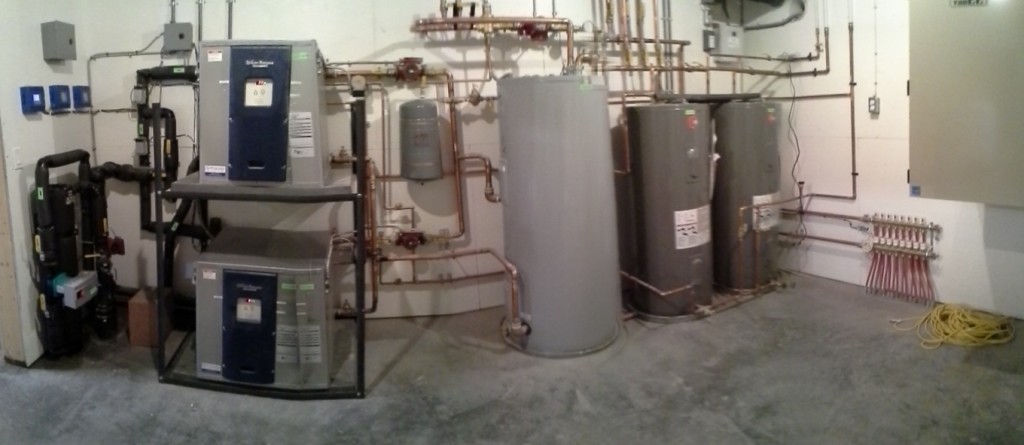
The Header Room

Our visit was part of the BCIT - CESA 8224 - Optimizing and Specifying Geoexchange Systems I course, taught by Ed Lohrenz of Practical GeoExchange Solutions. This is the first time for the program and it is rare (if not impossible) to find any formal program in geoexchange systems.


→ No CommentsTags: news · geothermal